the Entire Hiring Workflow
Recruitment management software helps organisations manage the complete hiring process, from job requisitions and candidate screening to interviews, offers, and pre-joining formalities. inLynk Talent connects these activities through its Recruit and Candidate platforms, making recruitment more organised, visible, and easier to manage.
For HR teams, managing these stages efficiently requires more than a basic applicant tracking system. They need a connected platform that helps recruiters, hiring managers, interviewers, and candidates work together throughout the recruitment journey.
This is where inLynk Talent makes a difference. Its integrated recruitment platform brings the major hiring activities into one connected environment. From creating job openings and screening resumes to conducting assessments, scheduling interviews, managing offers, and verifying documents, inLynk Talent helps organisations handle each recruitment stage through a structured workflow.
In this article, we explore how inLynk Talent streamlines the entire hiring workflow, the features that support each recruitment stage, and how an all-in-one recruitment platform helps organisations manage their hiring operations more effectively.
Table of Contents
- Understanding the Challenges in Traditional Recruitment
- What Is Recruitment Management Software?
- How inLynk Talent Manages Each Stage of Hiring
- Key Benefits of Using inLynk Talent for Recruitment Management
- Traditional Recruitment Process vs. inLynk Talent Recruitment Management Software
- Why Choose an All-in-One Recruitment Platform?
- Frequently Asked Questions
Understanding the Challenges in Traditional Recruitment
Hiring the right people is important for every organisation, but managing the recruitment process can become difficult when different activities are handled through separate tools, emails, and spreadsheets. Recruiters often need to coordinate with hiring managers, review resumes, arrange interviews, collect feedback, and keep candidates informed.
When these activities are not connected, information can become scattered, approvals may take longer, and recruiters may spend more time on administration than evaluating candidates.
According to the SHRM 2025 Recruiting Executives Benchmarking Report, the median time to fill a position is approximately a month and a half. The report also highlights that more than half of organisations have dedicated recruiters managing recruitment requirements. These findings show why organisations need organised hiring processes and better visibility across recruitment activities.
Some common recruitment challenges include:
- Manual job approvals: Getting approval from multiple stakeholders through emails can delay job publishing.
- Scattered candidate information: Resumes, contact details, and interview feedback may be stored in different locations.
- Time-consuming resume screening: Reviewing large numbers of applications manually can increase recruiter workload.
- Interview scheduling difficulties: Finding suitable time slots for candidates and interviewers requires coordination.
- Limited application visibility: Recruiters and candidates may struggle to understand the current hiring status.
- Delayed communication: Candidates may not receive timely updates about assessments, interviews, or offers.
An organised recruitment process helps address these issues by bringing hiring activities together in one system.
What Is Recruitment Management Software?
Recruitment management software is a digital platform that helps HR teams plan job openings, manage applications, screen candidates, conduct assessments, schedule interviews, coordinate offers, and monitor recruitment progress.
Unlike basic applicant tracking tools that mainly focus on candidate records and application stages, a broader recruitment management platform can connect multiple activities across the hiring lifecycle.
A cloud-based recruitment software solution can also help recruiters and hiring managers access relevant information without depending on separate spreadsheets or manual updates.
inLynk Talent follows this connected approach through two applications:
- inLynk Talent Recruit: An internal recruitment workspace for recruiters, hiring managers, interviewers, and administrators.
- inLynk Talent Candidate: A candidate portal for discovering jobs, applying, tracking applications, completing assessments, scheduling interviews, and managing offers.
Both applications operate on a shared data model. This means activities performed by recruiters and candidates are reflected in the same recruitment record, without requiring a separate synchronisation process.
Simplify Your Hiring Process with inLynk Talent! Manage recruitment activities, track candidates, and coordinate hiring teams through one connected platform. Explore inLynk
How inLynk Talent Manages Each Stage of Hiring
inLynk Talent connects the major stages of recruitment, helping organisations manage hiring activities through a structured workflow.
1. Simplifying Job Requisition Management and Approvals
Every hiring process starts with identifying a vacancy and getting approval to fill it. Managing this stage manually can create confusion about job requirements, responsibilities, and approval status.
inLynk Talent Recruit allows organisations to create and manage job openings with details such as:
- Job title, department, division, and location
- Employment type and experience requirements
- Salary bands and hiring priority
- Required skills and proficiency levels
- Assigned recruiters, hiring managers, and interviewers
- Headcount and interview round configuration
The platform also supports configurable multi-step approval workflows. Approvals can be assigned to specific roles or named individuals, with sequential or optional parallel steps.
Once the required approvals are completed, authorised administrators can publish the opening. A readiness check also ensures that a recruiter is assigned and salary information is available before publishing.
This makes job requisition management more structured and provides a clear record of approval activities.
2. Managing Candidate Sourcing and Resume Screening
After a job is published, the next step is attracting suitable applicants and reviewing their profiles.
inLynk Talent supports hosted careers pages where candidates can browse available openings without creating an account first. Job opportunities can also be distributed through supported integrations, including LinkedIn and Naukri posting integrations, along with Indeed and Glassdoor job feeds.
Recruiters can add candidates individually or upload up to 10 resumes at once. The platform also supports optional AI resume parsing, which extracts information such as:
- Contact details
- Professional experience
- Educational qualifications
- Skills and proficiency
- Employment history
This information can be used to pre-fill candidate profiles and reduce repetitive data entry.
In addition, optional AI screening can compare a candidate’s resume with job requirements and generate a score from 0 to 100. The scoring process considers content, technical skills, execution, and timeline, with configurable weightings and grade bands.
Recruiters can use these insights as an initial screening aid while retaining control over hiring decisions.
3. Improving Candidate Pipeline Management
Once applications start arriving, recruiters need a clear view of where every candidate stands.
inLynk Talent Recruit provides an eight-stage application pipeline:
- Applied
- Screening
- Interview
- Offer
- On Hold
- Hired
- Rejected
- Withdrawn
Recruiters can manage applications through a drag-and-drop board and view stage-wise candidate counts. Search and filtering capabilities help locate applications across the pipeline.
The platform also maintains application status history with timestamps and the person responsible for each action. This gives recruitment teams a clearer record of candidate movement.
Candidates receive a corresponding application-tracking experience through inLynk Talent Candidate. They can view their application status, follow progress through the hiring stages, and access relevant application details.
This connection helps recruiters and applicants stay aligned throughout the recruitment journey.
4. Simplifying Candidate Assessments and Interviews
Evaluating candidates involves more than reviewing resumes. Organisations may need technical tests, written assessments, interviews, and structured feedback before making a hiring decision.
inLynk Talent provides a reusable question bank with multiple question types, including multiple-choice, open-ended, technical, and coding questions.
Recruiters can create assessments using:
- Hand-picked questions
- Questions selected through defined criteria
- Random question selection
Assessments can include configurable duration, pass marks, attempt limits, question shuffling, and negative marking. The platform also supports assessment integrity controls such as tab-switch detection, full-screen enforcement, webcam snapshots, and violation tracking.
For interviews, recruiters can configure multiple rounds, schedule interviews directly, or allow candidates to select from available time slots.
The scheduling system considers interviewer availability, working hours, holidays, booking conflicts, and time zones. Built-in video rooms are also available for conducting online interviews without leaving the platform.
After each interview, assigned interviewers can submit structured feedback, including skill ratings, comments, and recommendations. Recruiters or administrators can review the feedback and make the round decision.
5. Managing Offers and Pre-Joining Formalities
Once a candidate successfully completes the selection process, recruiters can move towards the offer stage.
inLynk Talent Recruit supports offer creation with compensation details and configurable multi-level approval workflows. Approvers can provide electronic signatures, and the platform can generate offer-letter PDFs with signatures embedded in the required order.
Candidates can receive the offer through email and accept or decline it through inLynk Talent Candidate.
The platform also supports preliminary offer verification, allowing organisations to share proposed details such as designation, salary, location, and department before creating the formal offer.
For document verification, recruiters can request supporting documents from candidates, review uploaded files, and approve or reject them with reasons. Candidates can see document status and re-upload rejected documents when permitted.
These capabilities help organisations manage the final recruitment stages and prepare for the candidate’s joining process.
6. Monitoring Recruitment Performance Through Reports
Managing recruitment effectively also requires understanding how the hiring process is performing.
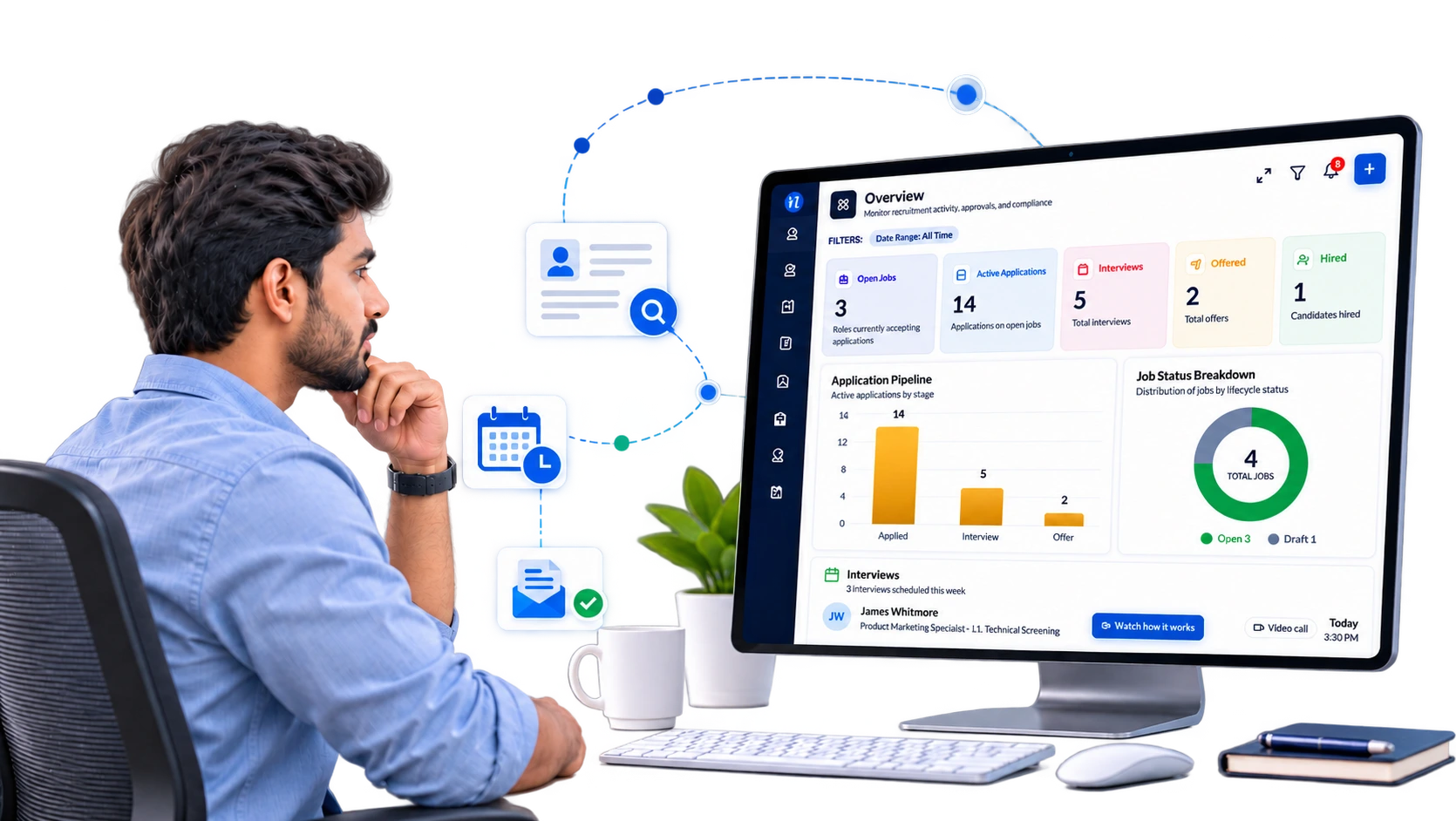
inLynk Talent Recruit provides reporting capabilities that help administrators and recruiters monitor:
- Overall hiring KPIs
- Application distribution across pipeline stages
- Job status breakdowns
- Today’s interviews and upcoming activities
- Recruiter performance
- Application-to-hire conversion funnel
- Recruitment activity across selected date ranges
Reports can also be exported in CSV format, making it easier to review recruitment information and share relevant data.
With these insights, recruitment teams can identify process bottlenecks, review hiring activity, and make better decisions about recruitment operations.
Key Benefits of Using inLynk Talent for Recruitment Management
By connecting recruiter activities and candidate interactions, inLynk Talent offers several practical benefits:
- Centralised recruitment management: Manage job openings, applications, assessments, interviews, and offers through connected applications.
- Reduced repetitive administration: Use resume parsing, configurable workflows, notifications, and automated reminders to reduce manual tasks.
- Better candidate visibility: Allow candidates to track applications, view interview details, and receive assessment and offer updates.
- Structured collaboration: Coordinate recruiters, hiring managers, interviewers, and administrators through defined permissions and approval processes.
- Improved hiring visibility: Use pipeline tracking and recruitment reports to understand application progress and hiring activity.
- Configurable workflows: Adapt approval chains, pipeline stages, assessment rules, calendar policies, and permissions to organisational requirements.
Traditional Recruitment Process vs. inLynk Talent Recruitment Management Software
The difference between traditional recruitment and a connected recruitment platform is how hiring information and activities are managed.
| Comparison Area | Traditional Recruitment Process | inLynk Talent Recruitment Management Software |
|---|---|---|
| Job Requisition Management | Job details managed through separate documents | Centralised job creation and management |
| Recruitment Approval Workflow | Manual email-based approvals | Configurable multi-step approval chains |
| Candidate Management | Candidate information stored across different files | Centralised candidate profiles |
| Resume Screening | Manual resume review | Optional AI resume parsing and screening |
| Candidate Pipeline Management | Spreadsheet-based status tracking | Eight-stage application pipeline |
| Assessment Management | Separate tools or manual test processes | Integrated question bank and assessments |
| Interview Scheduling | Manual coordination through emails | Availability-based scheduling and candidate self-booking |
| Interview Feedback | Feedback collected through separate channels | Structured interviewer feedback |
| Offer Management | Manual offer preparation and follow-ups | Offer approvals, electronic signatures, and PDF generation |
| Document Verification | Documents collected through separate channels | Application-based document upload and verification |
| Recruitment Reporting | Manual report preparation | Recruitment dashboards and exportable reports |
The comparison represents common differences between manual recruitment workflows and the capabilities documented in inLynk Talent. Actual outcomes depend on an organisation’s configuration and usage.
Why Choose an All-in-One Recruitment Platform?
Using separate tools for job approvals, resume screening, assessments, interviews, and offer management can make it harder to maintain consistent recruitment records.
An all-in-one recruitment platform brings these activities into a connected environment. It gives recruiters a structured way to manage vacancies, review candidates, coordinate with hiring teams, and track hiring progress.
inLynk Talent combines internal recruitment management with a candidate-facing portal, supported by configurable workflows, optional AI capabilities, reporting, and platform security controls.
Its shared data model is particularly important because recruiter-side actions and candidate-side activities update the same recruitment record. This reduces the need for separate imports or scheduled data synchronisation.
For organisations looking for cloud-based recruitment software that supports more than basic applicant tracking, this connected approach provides a practical foundation for managing recruitment operations.
Ready to Make Hiring Easier? Discover how inLynk Talent streamlines your recruitment workflow from job opening to offer management. Request a Demo
Conclusion
Managing recruitment requires coordination across multiple activities, from opening a vacancy to selecting the right candidate and completing pre-joining formalities. When these activities are handled separately, recruiters can face delays, scattered information, and limited visibility.
inLynk Talent brings the recruitment journey together through inLynk Talent Recruit and inLynk Talent Candidate. With job requisition management, candidate screening, pipeline tracking, assessments, interview scheduling, offer management, document verification, and reporting, it provides a connected approach to recruitment management.
For organisations looking to organise their hiring operations and improve coordination between recruiters and candidates, inLynk Talent offers an integrated platform designed to support the entire hiring workflow.
Frequently Asked Questions
What is recruitment management software?
Recruitment management software is a digital solution that helps organisations manage job requisitions, candidate applications, resume screening, assessments, interviews, offers, and recruitment reporting through a centralised system.
How does recruitment management software improve the hiring process?
It organises recruitment activities, reduces repetitive administrative work, improves candidate tracking, simplifies interview scheduling, and provides better visibility into hiring progress.
What is the difference between an ATS and recruitment management software?
An applicant tracking system (ATS) mainly focuses on managing candidate applications and tracking their progress. Recruitment management software can cover a wider range of activities, including job approvals, assessments, interview coordination, offer management, and recruitment reporting.
How does inLynk Talent support hiring workflow automation?
inLynk Talent supports configurable approval chains, application pipeline management, assessment workflows, interview scheduling, notifications, automated reminders, and offer approvals. Optional AI features also support resume parsing and candidate screening.
Can candidates track their applications through inLynk Talent?
Yes. inLynk Talent Candidate provides an application dashboard where candidates can view their application stages, follow progress, access interview details, review released assessment results, and manage offers.
Is inLynk Talent suitable for organisations with different hiring processes?
inLynk Talent supports organisation-level configuration of approval chains, pipeline stages, assessment rules, permissions, grade bands, email templates, and calendar policies. This allows organisations to adapt the platform to their recruitment requirements.
Leave a Reply